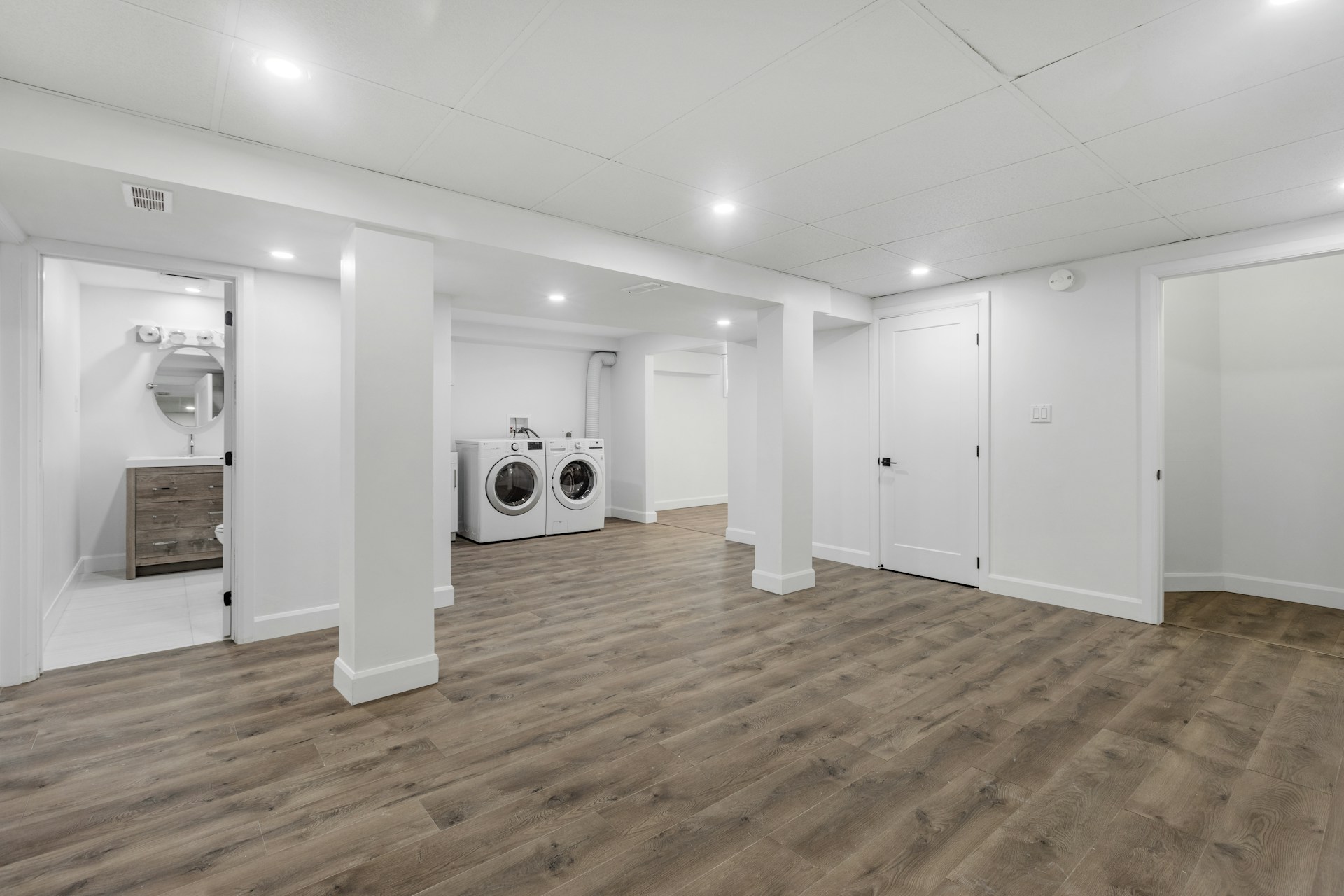

An unfinished basement is the cheapest square footage you’ll ever buy — but only if it’s done right. Moisture, egress, ceiling height, and HVAC are the four levers that determine whether you end up with a great room or a damp afterthought.
Before we frame a single wall, we evaluate the four things that determine whether a basement can be finished well in the first place.
Moisture. Any sign of efflorescence, water stains on the foundation, or musty smell needs to be diagnosed and fixed before drywall goes up. Sometimes the answer is grading and downspout extensions outside; sometimes it’s interior dimple board and a sump system; rarely it’s full perimeter drainage. We’d rather catch it on an estimate visit than find it during a Year 2 leak callback.
Egress. Any space being used as a bedroom requires a code-compliant egress window. Older basements often need new windows cut and wells excavated. Skipping this is the most common reason a finished basement fails to add appraised square footage.
Ceiling height. Code minimum is generally 7’ for habitable space; lower for under-beam. If your basement is at 7’0″, every duct chase and beam wrap is going to feel low. Sometimes a slight slab pour-down or alternative HVAC routing earns you usable height.
HVAC. Basements run cold; main-floor HVAC was sized for the main floor. We typically add returns and registers, sometimes a dedicated zone. Skipping this leaves you with a beautiful space nobody wants to spend time in.
- Moisture management — dimple board, sump pump check, perimeter drainage
- Framing and insulation — proper offset from foundation, vapor management, sound dampening between floors
- Egress windows — code-compliant for any sleeping space; oversized wells where needed
- Electrical and lighting — recessed cans, dedicated circuits for media, AV pre-wire
- Plumbing — bathroom rough-in, wet bar, laundry relocations
- HVAC — new returns, registers, and sometimes a dedicated zone
- Finish work — flooring, doors, trim, paint, custom built-ins
A typical project ends up as some combination of family room + bedroom + bathroom + storage. Home gym, theater, and home-office layouts are increasingly common, and we’ll walk you through what each implies for the build:
- A theater wants more sound dampening between joists and a darker palette.
- A gym wants a real subfloor (rubber over plywood, not floating laminate) so equipment doesn’t transmit shock to the slab.
- A home office wants more outlets and Cat-6 than you’d expect, plus dedicated lighting circuits.
- A guest suite wants a proper egress window, not just a borrowed-light situation.
The single most-regretted basement design choice is not leaving enough storage. Whatever’s in the unfinished space today doesn’t disappear when you finish it — it has to go somewhere. We almost always carve out a dedicated mechanical / storage room large enough to take the seasonal items, suitcases, and holiday bins that currently live in the open. Skip this and within six months you’ve got a finished basement that looks lived-in for the wrong reasons.
The mechanical room (furnace, water heater, electrical panel, water shutoff) needs real access for service and replacement. We frame that room with a 32-inch door minimum, leave clearances around each appliance to manufacturer spec, and route condensate drains and gas lines so the next service tech doesn’t have to undo a finished ceiling to reach them. A water heater is replaced 2–3 times in the life of a house; building a finished room around one with no path to swap it is a problem you create for future-you.
Basement-to-first-floor sound transmission is the most common post-finish complaint. Footsteps on the floor above carry through joists into the finished space below. There are real fixes — resilient channel on the basement ceiling, mineral-wool insulation between joists, decoupling fasteners — but they all need to happen before drywall. We’ll ask early what the space is for; a media room or guest suite needs more sound work than a workshop.
A common basement-finishing mistake is over-lighting with recessed cans on a 4-foot grid. This works in a 9-foot ceiling and feels oppressive in a 7-foot one. Lower ceilings want more, smaller fixtures spread out — combined with floor lamps and accent lighting that brings light away from the ceiling plane. Pendants over a bar or seating area pull the eye down and make the space feel taller than it is.